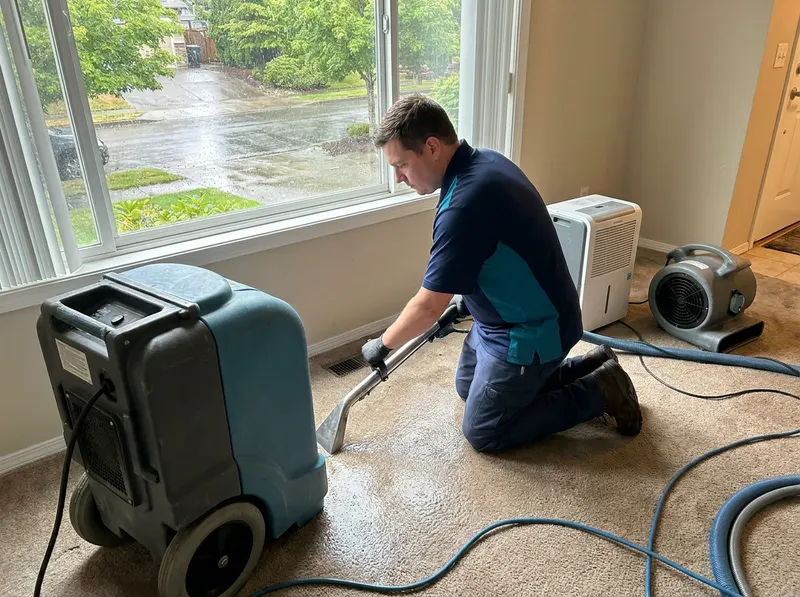
A burst supply line differs from a drain or sewage backup: the water is pressurized and usually clean (Category 1) or lightly contaminated gray water (Category 2), which changes how it is handled. Clean-water losses from a copper pinhole or a PEX split are dried in place where possible, saving drywall and hardwood; gray water from a dishwasher or washing-machine hose that has sat more than 48 hours is treated as contaminated and requires removal of soaked porous materials. The first step is confirming the line is shut off at the fixture valve or the main near the meter, most Seattle homes have the main shut-off in the basement, crawlspace, or an exterior box near the sidewalk. Extraction follows, then moisture mapping with a pin and pinless meter to trace how far water wicked under flooring and into wall cavities.
Seattle's older housing stock shapes this work. Homes in Ballard, Wallingford, and Wedgwood built before 1960 often carry galvanized or early copper supply lines prone to pinhole failures, and lath-and-plaster walls hold moisture longer than modern drywall, extending drying to 4, 6 days. Post-1990 construction in South Lake Union, Columbia City, and West Seattle townhomes typically runs PEX or CPVC, where the common failures are split lines in unheated garages and burst ice-maker or refrigerator hoses. Cold snaps, the December 2022 freeze that dropped Seattle into the teens is a documented example, cause clusters of burst lines in uninsulated crawlspaces and exterior-wall plumbing.
Decision guidance: if the leak was caught within a few hours and the water is clean, drying-in-place preserves hardwood and drywall and keeps the bill toward the lower end; if the water is gray, or has migrated under laminate or into insulation for more than two days, removal of the affected materials is the sound call because trapped moisture behind vapor barriers grows mold within 48, 72 hours. A second-floor supply-line burst that soaks into a first-floor ceiling almost always needs ceiling drywall opened for airflow. Note the limit: this service covers cleanup and structural drying, it does not include the plumbing repair itself; a licensed plumber must replace the failed line, and that visit is billed separately.
The sequence in plain steps: 1) the line is shut off and pressure released; 2) standing water is extracted with truck-mount or portable units; 3) moisture is mapped and marked; 4) saturated non-salvageable materials are removed; 5) air movers and dehumidifiers run with daily readings; 6) the space is confirmed dry to meter before any rebuild. Most homeowner insurance policies cover sudden accidental discharge from a burst pipe, and documentation, photos, moisture logs, and a scope, is provided for the claim.